Research
My research from 2013 to 2024, from the aerodynamics of a single blade to the reliability of continental energy systems. Since 2025, my work has shifted from academic research to applied energy-system modelling and open-source development. What I work on now.
Climate-resilient, net-zero energy systems
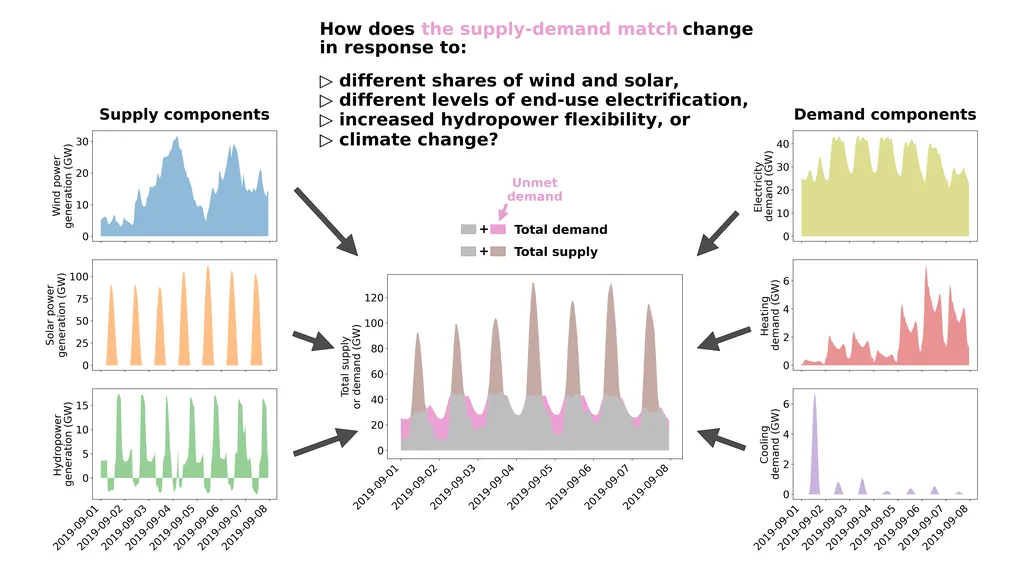
Decarbonising electricity is central to limiting climate change, cutting dependence on fossil fuels and improving energy security. But the more an electricity system relies on wind and solar, the more exposed it becomes to weather variability and to a changing climate. This research asks how to design deeply decarbonised electricity systems that stay reliable under rising climate risk.
I showed that system flexibility drives the optimal siting of distributed wind and solar generation, and that the value of adding more of them moves from quantity to quality of supply as their share grows (Antonini et al. 2021, 2022). I contributed to analysing how many years of past weather are needed to plan least-cost wind, solar and storage systems that meet demand reliably (Ruggles et al. 2024). And to give modellers the inputs this work needs, I produced more than a century of open, weather- and climate-driven time series of power supply and demand (Antonini et al. 2024).
Geophysical limits to wind power
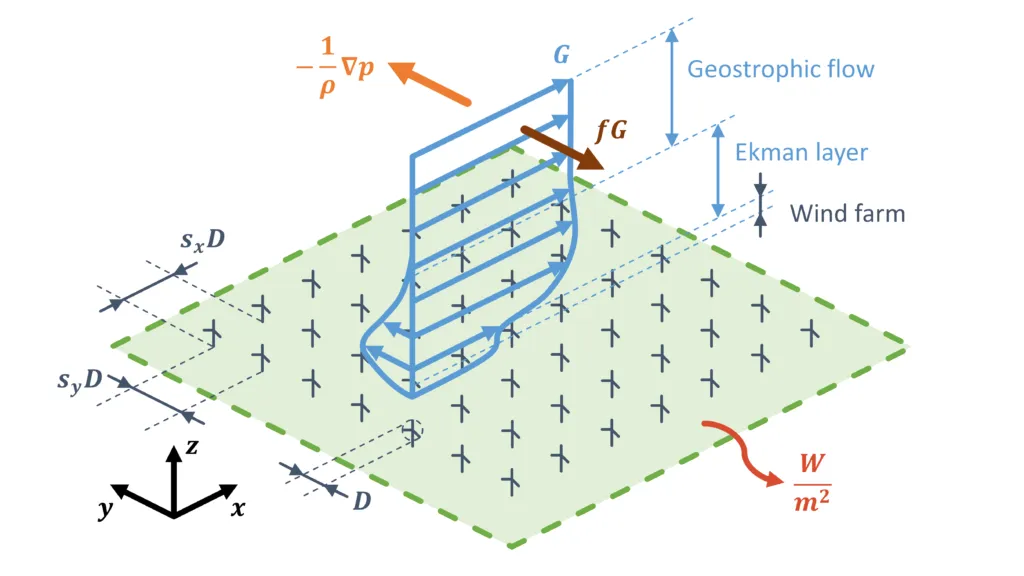
This research asks what controls the power that regional-scale wind farms can extract and, more broadly, how available and reliable wind power is across the globe. The limit on the power density of very large wind farms is set by how fast the atmosphere replenishes the kinetic energy that turbines remove.
Using atmospheric simulations and analytical expressions, I showed how atmospheric pressure gradients and the latitude-dependent Coriolis parameter control the power density of large wind farms (Antonini et al. 2021a). I then identified the length scale at which a wind farm reaches its generation limit, a physical explanation of how wind farms scale and a spatial constraint on large-scale expansion of wind power (Antonini et al. 2021b). Most recently, a global analysis of wind droughts showed where wind power generation is most reliable (Antonini et al. 2024).
Wind farm layout optimisation
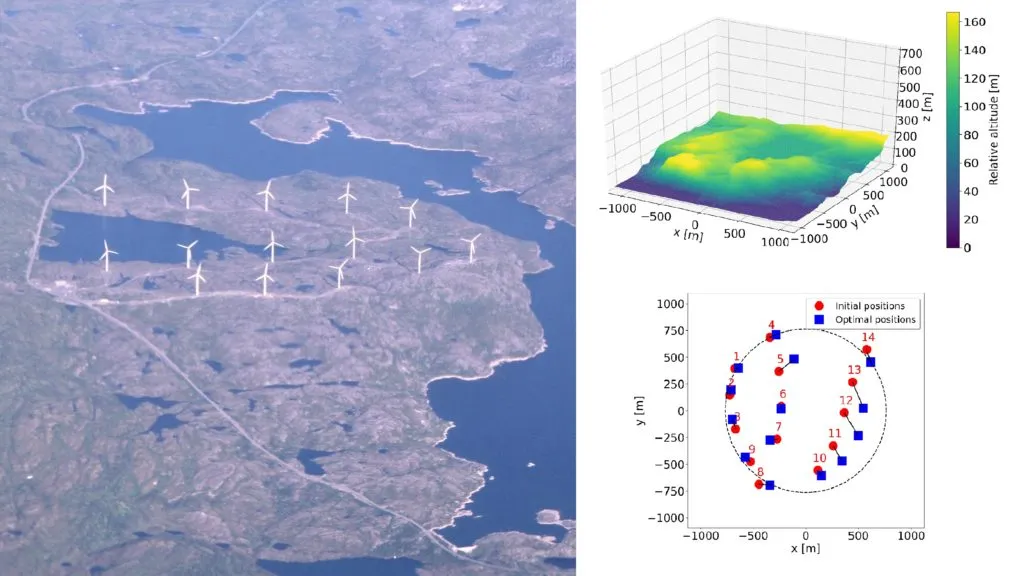
Where turbines are placed is one of the most important design decisions for a new wind farm. As each turbine extracts energy from the wind, it leaves a wake that slows the turbines downstream and lowers the farm’s annual energy production. My work on computational modelling and design optimisation addressed this problem.
I analysed how turbulence modelling affects computational fluid dynamics (CFD) simulations of turbine wakes and gave recommendations for their use (Antonini et al. 2016, 2018a). I showed that wind direction uncertainty explains much of the usual gap between CFD predictions of wake wind speed and field measurements (Antonini et al. 2019). To bring CFD into design, I developed an adjoint method that computes gradients for gradient-based optimisation at a fraction of the usual cost (Antonini et al. 2018b). This made it possible, for the first time, to optimise wind farms in complex terrain under realistic ambient conditions and flow structures (Antonini et al. 2020). I also contributed to a layout optimisation algorithm based on probabilistic inference (Dhoot et al. 2021) and to predicting wake losses with deep convolutional neural networks (Romero et al. 2024).
Wind turbine aerodynamics
Accurate aerodynamic models are essential to designing wind turbines well. During my master’s degree, I worked on computational models of both horizontal- and vertical-axis turbines. Their design methods usually rest on blade element momentum theory, which is only as accurate as the lift and drag curves of the airfoils it uses.
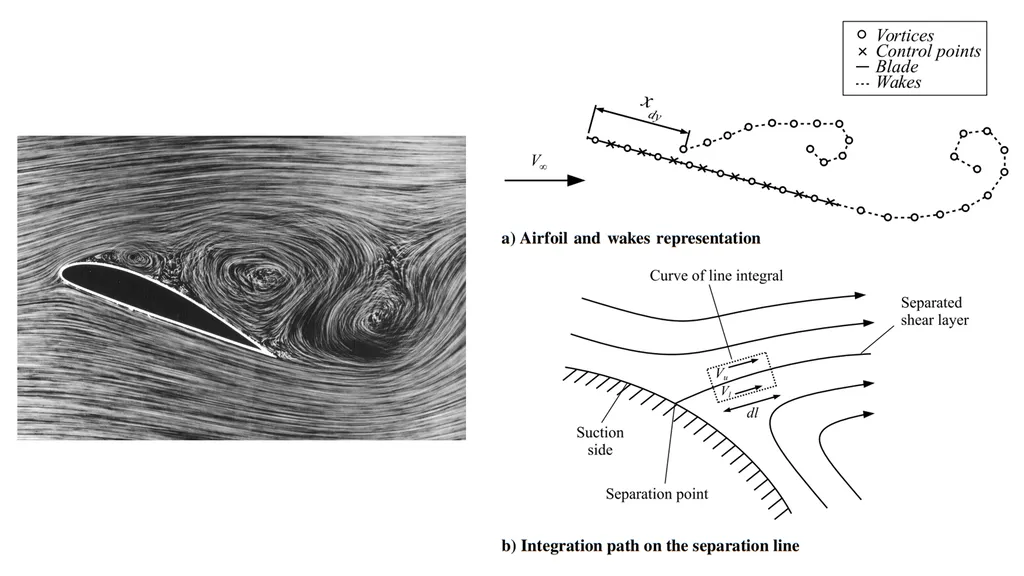
To test that accuracy, I reviewed and compared four widely used databases of aerodynamic coefficients for vertical-axis turbine simulations, and gave designers practical guidance for different rotor sizes and operating conditions (Bedon et al. 2014). I also developed models based on vortex theory to analyse rotor performance and support new design procedures. A discrete-vortex model I proposed simulated the complex dynamic stall of turbine blades in excellent agreement with experimental data, at reduced computational cost (Antonini et al. 2015).